
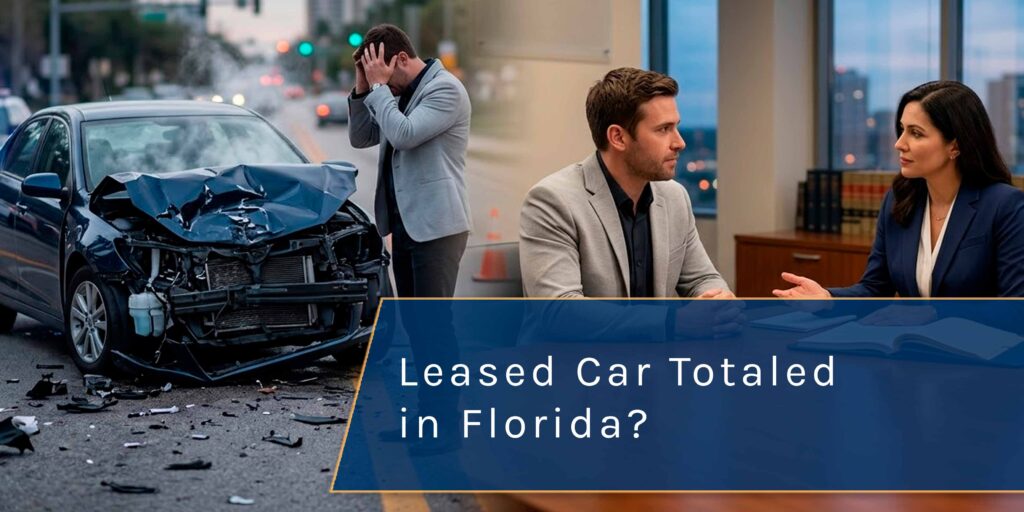
Leasing a vehicle feels straightforward until a serious crash turns it into a financial puzzle. When you are dealing with a leased car in Florida that has been totaled, one question immediately rises to the top: Who is responsible for the remaining balance?
The answer is rarely simple. It depends on the insurance coverage available, the lease payoff amount, liability for the accident, and whether gap coverage applies. Many drivers do not realize that the decisions made in the first hours and days after the crash can significantly affect both the financial outcome and any related injury claim.
Understanding how Florida insurance law interacts with lease agreements is critical before accepting any settlement or signing release documents.
Table of Contents
What to Do After a Florida Car Accident
When you are facing a leased car in Florida that has been totaled, early steps affect who pays the lease balance and how insurers calculate the loss.
- Call 911 if anyone is hurt. A police report documenting fault can directly impact which insurance policy pays the lease payoff.
- Get the accident report number. Confirm how to obtain the full report. Liability findings matter in lease balance disputes.
- Take clear photos. Capture vehicle damage, license plates, road conditions, traffic signals, debris, and skid marks. Insurers closely evaluate total loss claims.
- Seek prompt medical care. Even minor symptoms should be documented. Treatment gaps can reduce overall claim value.
- Do not accept early settlement offers. Insurance companies calculate total loss value and lease payoff carefully. Their first number is often not their final number.
Most importantly, speak with a Florida car accident attorney before signing releases or agreeing to a payout. When a leased vehicle is totaled, insurers are focused on limiting exposure, not protecting you from a remaining balance.
Who Pays the Balance and Why Ownership Matters in a Leased Car Accident Claim
If you are leasing your car, the leasing company owns the vehicle and holds title. When the car is declared a total loss, the insurer pays actual cash value directly to the lessor, which applies the funds to the lease payoff.
What Happens If the Insurance Payment Does Not Match the Payoff?
If the insurance payout is less than the lease payoff amount, the remaining difference becomes a potential deficiency balance. This is common early in a lease, when depreciation reduces the vehicle’s market value faster than the payoff balance declines. Without gap coverage, that shortfall can become your responsibility. Depending on the lease terms, early termination charges or unpaid amounts may also affect the final number.
On the other hand, a surplus may exist if the insurance payout exceeds the payoff amount. However, the lease agreement controls how excess funds are handled. Fees and contractual provisions may reduce or eliminate any refund. For that reason, you should request a final itemized payoff statement to confirm how the balance was calculated.
Insurers pay actual cash value, while leases require contractual payoff, so discrepancies are common. A low valuation can leave you owing a balance. A Florida car accident attorney can review the lease, verify the payoff, assess gap coverage, and challenge the offer before the claim closes.
When Do Insurers Declare a Total Loss?
After a Florida car accident, the insurer decides whether to repair the vehicle or declare it a total loss by comparing repair costs to its actual cash value under Florida’s threshold rules. Although Florida law governs title branding, insurers also apply their own economic total loss analysis when making the decision.
The payout usually ties to actual cash value (ACV), which reflects fair market value just before the crash. Condition, mileage, prior damage, and options all matter. For example, high mileage often reduces ACV, while newer tires may increase it. Importantly, insurers commonly use market databases and third-party valuation tools.
Your Florida car accident lawyer compares the insurer’s number to real listings in your area. If the valuation misses features, with the help of your lawyer, you can challenge it.
Your Leased Car in Florida is Totaled: Which Insurance Coverage Pays the Balance?
When a leased vehicle is declared a total loss, the type of coverage involved determines whether the lease payoff is fully covered or whether you could still owe money.
- Collision coverage (required in most leases) pays actual cash value minus your deductible and applies it to the lease payoff. A shortfall may remain.
- Property damage liability applies if another driver is at fault, but Florida’s $10,000 minimum is often insufficient, requiring you to use your own collision coverage first.
- Comprehensive coverage applies to non-collision losses like theft or flood and pays actual cash value toward the lease balance.
- Gap coverage may cover the difference between the payout and the remaining lease payoff. Without it, you may owe the deficiency.
Insurers pay actual cash value, while your lease requires contractual payoff. If those numbers do not align, you may owe the difference. A Florida car accident lawyer can review the lease, verify the payoff, assess gap coverage, and challenge a low valuation before insurance finalizes the claim.
Why Gap Insurance Can Make or Break a Car Accident Claim in Florida
In many leased car accident claim cases, gap insurance determines whether you owe money, since insurers pay actual cash value while leases require full payoff.
Gap coverage may come from:
- The lease agreement itself
- A dealership add-on product
- An endorsement on your auto insurance policy
But not all gap policies cover every shortfall. Many exclude:
- Late payments or late fees
- Excess wear and tear charges
- Prior unrepaired damage
- Certain deductibles
- Negative equity rolled into the lease
Problems arise when drivers assume gap coverage fully protects them, only to discover exclusions. If a dispute arises, a Florida car accident attorney can review the policy and challenge improper denials before the insurer finalizes the claim.
How to Dispute a Low Total Loss Valuation in a Florida Car Accident
In a leased car claim in Florida, a low valuation can increase the deficiency balance and leave you owing thousands, since insurers base payouts on their valuation reports.
A Florida car accident attorney will typically examine whether the insurer:
- Used the correct trim level and factory options
- Listed accurate mileage
- Improperly deducted for pre-crash damage
- Applied appropriate taxes and required fees
- Selected truly comparable local vehicles
Supporting documentation can significantly affect the valuation. Strong evidence may include:
- Comparable local listings with similar mileage and trim
- Photos showing the vehicle’s condition before the crash
- Receipts for recent maintenance, new tires, or major service
- Documentation of upgrades, packages, or added equipment
If the gap between valuation and lease payoff is significant, the insurance policy may allow for a formal appraisal or dispute process. These procedures are contractual and deadline-driven. In a situation where your leased car has been totaled valuation disputes are not just technical details. They directly determine whether you walk away clean or remain liable for a deficiency balance.
Leased Car Accident Claims in Florida: Common Mistakes That Cost You Money
Mistakes happen quickly after a crash. If you have a leased car in Florida that has been totaled, those mistakes can be expensive.
Avoid these common errors:
- Stopping lease payments without written confirmation. Continue payments unless the leasing company provides clear written instructions about billing and payoff timelines.
- Accepting the first valuation without review. Errors in mileage, trim level, options, or condition directly affect actual cash value and can increase any deficiency balance.
- Delaying medical treatment. Treatment gaps can reduce available PIP benefits and weaken credibility if an injury claim develops later.
- Leaving the vehicle in storage without coordination. Storage fees can accumulate daily. However, do not authorize release, salvage, or disposal without direction from both the insurer and the leasing company.
- Signing broad releases too early. Property damage resolution and injury claims are often separate issues. Settling one prematurely can affect the other.
When a leased vehicle totals, small mistakes can create lasting financial consequences. Before you make decisions that affect valuation, payoff, or settlement, consult a Florida car accident attorney to protect your position.
FAQs (Frequently Asked Questions)
Who owns a leased vehicle in Florida and how does this affect total loss claims?
In most leases, the leasing company owns the vehicle and holds title; you only have the right to use it. In a total loss, insurers pay the lessor first to satisfy the lease payoff, which can limit your leverage if you delay notice.
How do insurers determine if my leased car is a total loss in Florida?
Insurers compare repair costs to the vehicle’s actual cash value before the crash. If repairs approach or exceed that amount, they declare a total loss under Florida rules, applying both title-branding standards and their own economic loss analysis. They calculate actual cash value using condition, mileage, prior damage, and market data.
What insurance coverages apply when my leased car is totaled in Florida?
Collision coverage, required in most leases, pays damages minus your deductible toward the lease payoff. If another driver caused the crash, their property damage liability coverage may apply. If the vehicle is totaled by a non-collision event such as theft or fire, comprehensive coverage applies.
Who pays the balance on my lease if my leased car is totaled in Florida?
The insurer pays actual cash value to the leasing company to cover the payoff. If the payout is lower, you may owe the difference unless gap coverage applies. If it is higher, the lease controls any surplus. Request a final payoff statement and review your contract.
How does gap insurance protect me if my leased car is totaled in Florida?
Gap insurance covers the difference between your vehicle’s actual cash value payout and your remaining lease balance when depreciation leaves you owing more than the car is worth. Your lease, dealership, or auto policy may provide it.
Make Sure You Are Not Left Paying the Balance
A leased car claim in Florida can quickly become a financial problem if the valuation is low or the lease payoff is higher than expected. Before accepting a settlement or signing any release, make sure you understand how the payoff, gap coverage, and insurer’s numbers affect you. If your insurance declares a total loss, the crash likely involved significant force, and you may also be dealing with injuries, medical treatment, and missed work. Depending on the severity of your injuries and whether your injury meets the legal threshold, you may be entitled to pursue compensation, including lost income and other damages.
Contact us today to schedule a free consultation and get clear guidance about your next steps. Regardless of whether you are dealing with a lease payoff dispute, a gap coverage question, or potential injury compensation, getting timely legal advice can help you avoid costly mistakes and protect your financial recovery.