
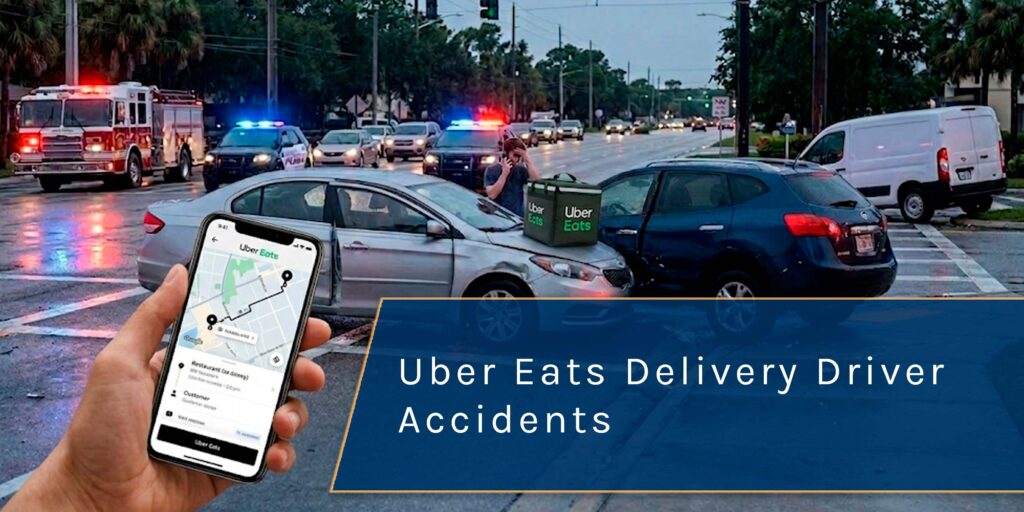
Food delivery services like Uber Eats are now a routine part of daily traffic across Florida, including busy areas like Hillsborough County and Pinellas County. With nearly 400,000 crashes reported statewide, Florida roads are already high-risk. The rise of app-based delivery adds even more vehicles making frequent stops, quick turns, and repeated trips through dense neighborhoods and commercial zones. As a result, Florida Uber Eats delivery accidents are becoming an increasing concern in high-traffic areas.
Delivery drivers operate differently than typical commuters. They stop more often, pull into unfamiliar areas, and navigate tight residential streets throughout the day. This pattern increases the risk of rear-end crashes, backing collisions, and pedestrian incidents. A tragic example occurred in 2021, when an Uber Eats driver in Tampa allegedly struck and killed a University of Tampa student while distracted by her phone, according to a lawsuit.
At the same time, the structure of app-based work creates constant time pressure. Drivers must meet delivery windows, follow GPS directions, and manage orders through their phones. As a result, many Florida Uber Eats delivery accidents involve a combination of distraction, rushed driving decisions, and heavy traffic conditions, especially in high-density areas like Tampa Bay.
Table of Contents
Common Causes Of Uber Eats Delivery Collisions
Most Florida Uber Eats delivery accidents come from predictable behaviors. However, the delivery app environment makes those behaviors more likely.
Common causes include:
- Distracted driving from texting, scrolling, and in-app messages
- GPS navigation checks while moving
- Speeding to meet drop-off times
- Unsafe turns across traffic
- Following too closely in stop-and-go congestion
- Sudden stops near restaurants, condos, and gated communities
The National Highway Traffic Safety Administration (NHTSA) has repeatedly warned about distracted driving risks. In particular, NHTSA reports thousands of deaths each year tied to distraction. Cell phones remain a leading source of driver distraction. Therefore, food delivery drivers face a higher risk because the phone is part of the job.
Time pressure also changes decision-making. A driver who wants to complete “one more” delivery may speed through a yellow light. Similarly, a driver may glance at the app instead of checking a crosswalk. Those choices can support a negligence claim, and sometimes even a reckless driving theory, depending on the facts.
What To Do Right After A Crash With A Delivery Driver
After Florida Uber Eats delivery accidents, what you do in the first minutes matters. You need to protect your health first. You also need to preserve evidence before it disappears.
- Get to safety and call 911. Move out of traffic if you can. Ask for medical help, even if pain feels minor.
- Document the scene fast. Take photos of vehicle positions, damage, skid marks, traffic signals, and road signs. Include visible injuries too.
- Confirm delivery status. Ask the driver if they were active on Uber Eats. If they share order details, note the restaurant, drop-off area, and time.
- Collect key information. Get the driver’s name, phone number, license plate, and insurance cards. Also, collect witness names and numbers.
- Look for nearby cameras. Check for businesses, intersections, and doorbell cameras that may show the crash.
- Request the police report number. This helps later with insurance disputes and claim documentation.
- Contact a Florida car accident attorney. A skilled lawyer helps protect your claim and pursue fair compensation.
Do not rely on the driver’s verbal assurances. Also, do not assume the insurance situation is simple. Florida Uber Eats delivery accidents often trigger coverage arguments from day one.
Evidence That Often Makes Or Breaks These Claims
Insurance companies decide cases based on proof, not assumptions. That is why evidence matters so much in Florida Uber Eats delivery accidents.
Delivery app data can be critical because “on-duty” status can change which policy applies. Insurers often fight over whether the driver had the app on, had accepted an order, or had food in the car. Because of that, you should try to preserve any details tied to the delivery.
High-value evidence often includes:
- App status and trip timestamps
- GPS route data and location history
- Screenshots of the delivery route or active order screen
- In-app messages and notifications
- Call logs that show communication near the crash time
- Dashcam footage and surveillance video
- Witness statements taken early, while memory stays fresh
Medical and wage proof also drives case value:
- ER records, imaging, and discharge notes
- Follow-up visits and specialist referrals
- Physical therapy records and mileage to appointments
- Prescriptions and medical equipment costs
- Pay stubs, missed time logs, and employer letters
If you wait, some evidence disappears. Video gets overwritten. Phone data gets lost. Therefore, early action can change the outcome of Florida Uber Eats delivery accidents.
Who May Be Liable In Florida Uber Eats Delivery Accidents
Florida law uses negligence principles. The at-fault party pays when careless driving causes harm. However, Florida Uber Eats delivery accidents can involve more than one negligent party.
Liability may rest with:
- The delivery driver
- Another motorist who caused or contributed to the crash
- A vehicle owner who negligently entrusted the car
- In limited situations, a company tied to the work arrangement
Employment status adds another layer of complication to these claims. Uber Eats delivery drivers work as independent contractors. That classification can limit direct claims against a company. Still, the facts matter. Control over routes, performance monitoring, quotas, and app-based direction can affect legal arguments about responsibility and available coverage.
How Insurance Coverage Works When The Driver Is Delivering
Florida Uber Eats delivery accidents often turn into coverage disputes because multiple policies may apply at different times. Personal auto insurance is usually the first issue. Many policies exclude coverage for “livery” or commercial use, which can lead to immediate denials when a driver was making deliveries.
At the same time, coverage tied to Uber Technologies, Inc. may apply, but only if certain conditions are met.
Uber Eats Insurance Coverage by App Status
Insurers look closely at what the driver was doing in the app at the time of the crash:
- App off: Only the driver’s personal auto insurance applies
- App on, waiting for an order: Limited coverage may apply, typically up to:
- $50,000 for injuries to one person
- $100,000 total for injuries per accident
- $25,000 for property damage
- Active delivery: When the driver is picking up or delivering an order, coverage can increase to up to:
- $1 million in third-party liability coverage
Insurers closely examine the driver’s app status, including whether the app was off, on but waiting for an order, or actively being used for a delivery. Each phase can trigger a different level of coverage, which is why building a clear timeline is critical.
Coverage disputes often involve multiple policies, including the driver’s personal auto policy, any commercial coverage, and company-provided liability coverage that may apply during an active delivery. Because these layers overlap, Florida Uber Eats delivery accidents frequently lead to delays, denials, and disputes before fair compensation is paid. For these reasons and more, if you have been injured by an Uber Eats driver while making a delivery, you should contact an expert personal injury lawyer.
Deadlines You Cannot Miss After Your Uber Eats Delivery Driver Accident
Deadlines control your leverage. If you miss them, you may lose your right to sue, even with strong evidence.
Under Florida Statutes § 95.11, most negligence claims, including car and delivery driver accidents, must be filed within two years of the crash. Wrongful death claims also carry a two-year deadline and follow separate rules under Florida Statutes § 768.21.
Do not wait for an insurer to “finish investigating.” Track the crash date and speak with a personal injury attorney early to protect your rights in Florida Uber Eats delivery accidents.
Compensation You Can Seek After A Delivery Driver Crash
Florida Uber Eats delivery accidents can cause serious harm. Compensation should match the full impact, not just the first hospital bill.
Economic damages may include:
- Emergency care, hospitalization, and surgery
- Rehabilitation, physical therapy, and follow-up treatment
- Medication and medical devices
- Lost wages and missed work opportunities
- Reduced earning capacity, if injuries affect long-term work
Non-economic damages may include:
- Pain and suffering
- Emotional distress
- Loss of enjoyment of life
In severe cases, additional damages may apply. However, the facts must support them. Documentation drives value, so keep records from the start. An experienced Florida delivery driver accident attorney can help preserve critical evidence, navigate complex insurance issues, and build a claim that reflects the full extent of your losses from the very beginning.
FAQs (Frequently Asked Questions)
What are the common causes of Uber Eats delivery collisions in Florida?
Common causes include distracted driving from apps or texting, checking GPS while moving, speeding to meet deliveries, unsafe turns, following too closely, and sudden stops. Smartphone use on the job increases distraction risk.
What steps should I take immediately after a crash involving a Florida Uber Eats delivery driver?
First, move to safety and call 911 if needed. Take photos of vehicles, damage, and the scene. Note if the driver was on a delivery. Collect driver and witness information, check for cameras, and get the police report number.
What types of evidence are crucial in supporting claims after Florida Uber Eats delivery accidents?
Critical evidence includes app status and trip timestamps showing if the driver was on-duty, GPS route data, screenshots of active orders, in-app messages, call logs near the crash time, dashcam or surveillance footage, and early witness statements. Medical records documenting injuries and wage loss proof also significantly impact case value.
Who can be held liable in Florida Uber Eats delivery accident cases?
Liability may involve the delivery driver, other motorists, a negligent vehicle owner, and in some cases a company tied to the work arrangement. Independent contractor status can further complicate these claims.
How does insurance coverage typically work when a Florida Uber Eats driver is involved in a crash during delivery?
Insurance claims often face disputes because personal policies may deny coverage for delivery use. Coverage depends on app status and the driver’s work arrangement at the time of the crash.
Take Action After a Florida Uber Eats Delivery Accident
Florida Uber Eats delivery accidents can become complicated quickly. Evidence can disappear within days, and insurance companies often move fast to shape the narrative. Adjusters may try to shift blame or argue that coverage does not apply. Acting early helps protect your rights and preserves the details that matter most.
A Florida personal injury lawyer can take control of the process from the start. That includes handling communication, securing key evidence like app records and video, and building a clear liability case supported by facts. Strong cases do not happen by accident. They require strategy, documentation, and the ability to push back against low offers or unfair denials.
If you were injured in a crash involving a delivery driver in Florida, contact us at Personal Injury Attorneys McQuaid & Douglas, so we can help you understand your options and take the next step. Schedule a free consultation so that we can give you clarity on your case and what it may be worth.